
The Budget PC Dream Meets a Harsh Reality
For years, budget PC builders had a simple target: match the Xbox Series S. Microsoft’s entry-level console offered a clear baseline for affordable gaming. If your PC could match its graphical horsepower, you were set for the generation.
Or so we thought.
As we head into the late months of 2026, that budget dream is officially dead. The culprit isn’t raw processing power. It’s memory. Specifically, video random-access memory (VRAM). PC gamers who built rigs around GPUs with 8GB of memory are finding themselves locked out of late 2026’s biggest releases, while the humble Series S continues to chug along.
The Shared Memory Trick
To understand why this is happening, we have to look at how these systems handle memory. The Xbox Series S features 10GB of unified GDDR6 memory. It’s a shared pool. The system reserves about 8GB of this high-speed memory strictly for games, leaving the rest for the operating system.
On paper, an 8GB PC graphics card should match this easily. But PC gaming doesn’t work in a vacuum. When you run a game on a PC, your graphics card has to share the load with your operating system and background apps. A typical Windows 11 system can easily eat up 1.5GB to 2GB of VRAM just keeping your desktop, Discord, and game launchers running. That leaves a budget 8GB graphics card with barely 6GB for the actual game.
Why Late 2026 Games Are Crashing the Party
The latest crop of holiday 2026 games, many built on mature versions of Unreal Engine 5, have pushed asset quality to the limit. High-resolution virtualized geometry and complex lighting systems demand massive amounts of memory. At 1080p on medium settings, these games routinely allocate over 9.5GB of VRAM.
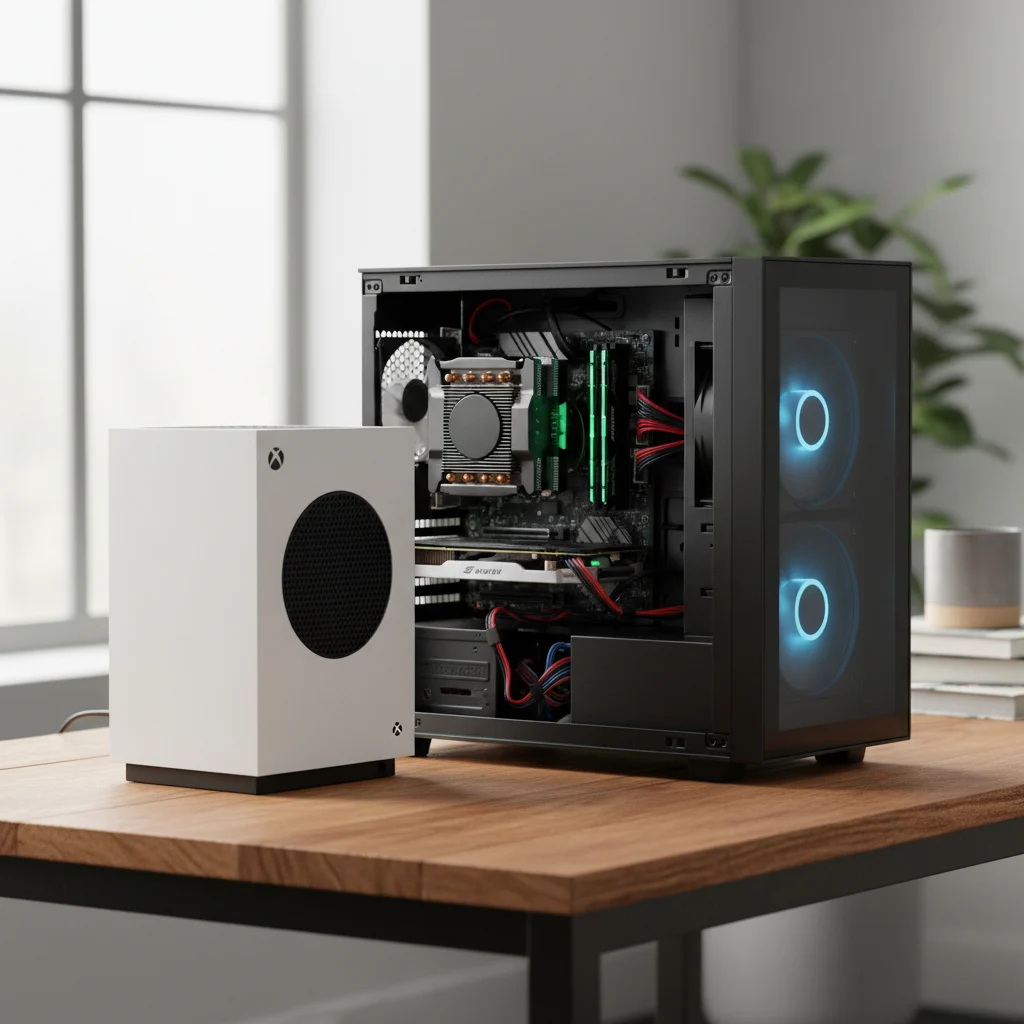
On a Series S, developers can optimize aggressively because they control the entire system. They can stream assets directly from the console’s custom SSD to bypass memory bottlenecks. But on a PC, asset streaming is rarely as efficient. When a PC game runs out of VRAM, it starts swapping data with your system RAM, which is painfully slow.
The results are rough:
- Severe, immersion-killing stuttering
- Frame rates dropping from a smooth 60 frames per second down to single digits
- Massive texture pop-in, where walls and characters look like muddy blobs for several seconds
The Expert Take on the Memory Crisis
“We’ve reached a tipping point where 8GB of VRAM is the new 4GB,” says Marcus Vance, a hardware analyst at PC Tech Labs. “In 2024, you could get away with lowering your settings. In late 2026, the game engine architecture itself expects a larger memory pool. If the memory isn’t there, the game simply chokes, regardless of how fast your GPU core is.”
On community forums, threads are flooded with complaints from users who bought budget GPUs over the last couple of years. Many are shocked to find their rigs underperforming compared to a cheap console.
What Should Budget Builders Do Now?
This shift leaves budget PC builders in a tough spot. For years, the go-to recommendation for a cheap build was an 8GB card like the AMD Radeon RX 6600 or the Nvidia RTX 3050. Today, those cards are struggling to run new titles even at the lowest possible settings.
To get a stable experience that actually beats the Series S, PC gamers now need to target at least 12GB of VRAM. This means spending more on newer mid-range cards or hunting down deals on older 12GB models. The era of the ultra-cheap console-killer PC is on pause. While the Series S continues to punch above its weight, budget PC players are learning a hard lesson: raw power means nothing without the memory to back it up.